Koan
Koan

The weather did not cooperate but March 25 was still a great day. After years, we unveiled John Portman’s Koan at Georgia Tech. It was an extraordinary moment for those of us who worked to make this a reality for many years. John never lived to see his magnificent last artistic design but his presence was palpable. John was one of the great architects of the world. Koan is an example of his extraordinary creativity. I hope that this iconic piece will inspire many and become a destination of all visitors to his beloved city of Atlanta and his alma mater, Georgia Tech.
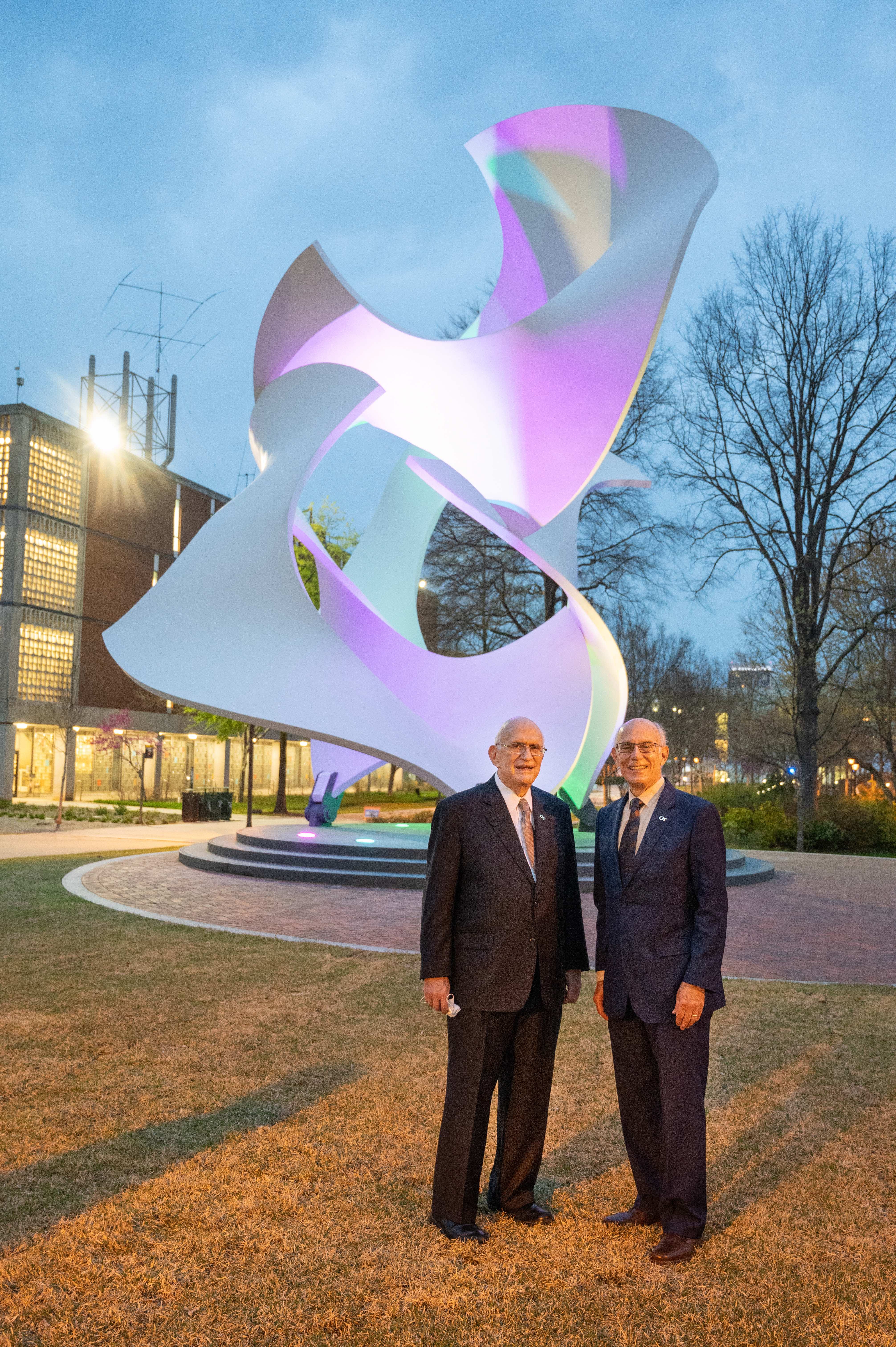
Koan Unveiling Comments
Rafael L. Bras
A paradoxical anecdote or riddle, used in Zen Buddhism to demonstrate the inadequacy of logical reasoning and to provoke enlightenment — that is the meaning of the word “Koan.” With this enigmatic sculpture, John Portman reminds us that creativity is not always about logic but about a flight of fancy which many times is found at the intersection of art and science.
The story of Koan goes back to February 2015. In a visit with John, I explained how our then nascent art initiative was having the desired impact of energizing the creativity of our students and at the same time rounding the sharp corners of our beautiful campus, literally and figuratively. I added that the campus and Atlanta needed an iconic piece of art, and who better to do it than John Portman – already an icon at Georgia Tech and in Atlanta. He looked at me, remained quiet for an endless minute and responded: “I will think about it.”
Think he did. Two and a half years later, in August 2017, I got a message from Mickey Steinberg — John wanted to talk to me. When I got to John’s offices, I was told that unfortunately he was not feeling well and could not make it to the meeting. I never saw John again. But Mickey and several other Portman associates took me to a conference room. In the middle of a large table, beautifully positioned and illuminated was a model of Koan. Mickey and some of his colleagues proceeded to explain the concept, the idea, including a video of a simulated flight, drive, and walk around the piece in its proposed location.
All that time, John had been indeed thinking and then quietly doing, even visiting campus incognito, to design — down to placement — what is now Koan. I was blown away. The piece was extraordinary. Its intricacy, built on simplicity, challenged the mind. Here was the icon I had dreamt of.
Reality quickly moderated exuberance. This was to be very difficult project. It would cost north of 7 figures to fabricate and install, and it presented enormous engineering problems: unique materials, difficult structures, challenges with anchoring and stability and logistics. Here is where many others came to the rescue. I cannot acknowledge all, but must acknowledge some.
More than 45 people and organizations contributed resources to this effort. The City of Atlanta, and then-Mayor Kassim Reed, recognized that Koan and Georgia Tech’s campus should be destinations for visitors. The City was the largest single donor through its own public arts initiative.The anchor individual gifts came from Dick Bergmark and David Flanagan. These two loyal Georgia Tech alums and friends have always been there to help me, and I will always be grateful. The various Portman organizations — and, in particular, Jack Portman — have contributed in a myriad of ways.
Sometime in the fall of 2017, Jack and I were having a late glass of wine in the Portman Ritz-Carlton in Shanghai. After some conversation, he told me: “We better hurry up with that sculpture — my father is not well.” John died at the end of that year — and who would have imagined that Jack, too, would not be with us today. He and his father are missed.
And there is Mickey Steinberg. Mickey is not only one of the top donors to this effort, but he pursued it, supervised it, and managed it with the passion that can only come from an individual trying to honor a fallen dear friend, a brother. This project would not have happened without Mickey. If there is a silver lining to the 18-month delay in this complicated project, it’s that I had the opportunity to work even longer with Mickey.
Yes, we pulled our meager hairs with the setbacks, we shared frustrations and tense moments, but we were both absolutely committed to see this through. Between the project discussions, we shared hours of stories about our lives. One of the topics I enjoyed the most was talking about the travails that religious, racial, and ethnic minorities still suffer in this country.
Mickey, you lost an irreplaceable friend in John, but I gained a friend, and an advisor, in you. Thank you. With that, let me introduce the godfather of Koan, Mickey Steinberg.